


Welcome to our first update of 2026….we wish you all the very best for the new year.
This month, we reflect on a recent cut in base rate and look forward to what the market may bring in 2026
Scroll on…..
The 2026 UK mortgage market is starting the year in a noticeably better place for borrowers, with the Bank of England base rate now at 3.75% and expectations of further, gradual easing if inflation continues to edge down.
The outlook is one of cautious optimism: cheaper funding, modest house price growth and a market that rewards good‑quality applications rather than speculative borrowing.
With Bank Rate cut from 4% to 3.75% in December 2025, tracker customers have already seen an immediate reduction in monthly payments, and most lenders are passing on cuts to standard and base mortgage rates.
Market commentators expect at least one more reduction this year, with some forecasts suggesting Bank Rate could reach 3.25% by the end of 2026 if inflation trends allow.
With HSBC already reducing rates, fixed-rate pricing is responding, too. Two‑year fixes are expected to test sub‑3% territory by spring if wholesale markets remain supportive, while competitive five‑year fixes in the mid‑3% to low‑4% range are increasingly realistic for stronger‑equity borrowers.
This is a far cry from the ultra‑low deals of the 2010s, but represents a material improvement on the peaks seen in 2023–24.
Leading forecasters, including Nationwide, Savills and Rightmove, broadly expect UK house prices to rise by around 2–4% in 2026, signalling a gentle recovery rather than a boom. Lower‑priced regions such as Scotland, the North and the Midlands are tipped to outperform, while London and much of the South are likely to lag as higher values and taxes continue to bite.
Transaction volumes should remain steady rather than surging. UK Finance-linked projections point to around 1.2 million sales across 2026–27, reflecting cautious, needs‑based moves from first‑time buyers, movers and remortgagers as affordability gradually improves.
Forecasts suggest gross mortgage lending will grow modestly in 2026, helped by a strong remortgage pipeline as earlier fixes expire into a lower‑rate environment. Net lending growth is expected to run in low single digits, consistent with a stabilising, sustainable market rather than a credit-fuelled upswing.
For borrowers, the story is one of slowly easing pressure: lower rates, slightly stronger real wages and more choice of products, from green and later‑life options to innovative affordability solutions.
However, deposit requirements, tighter stress testing and higher absolute repayment levels than pre‑2022 mean high‑quality advice remains essential to navigate the 2026 landscape confidently.
We are here to help – please just let us know if you have any questions!
Below we have listed the lowest rates available across a range of LTVs.
Please note these are for illustration purposes only – not all clients may qualify for these. If you need any additional detail, please let us know,
| 95% | 90% | 85% | 80% |
|---|---|---|---|
|
4.65% - Leeds BS
|
4.23% - Virgin Money
|
4.02% - Halifax
|
4.02% - Halifax
|
| 75% | 70% | 65% | 60% |
|---|---|---|---|
|
3.90% - Barclays
|
3.90% - Barclays
|
3.90% - Barclays
|
3.82% - Halifax
|
| 95% | 90% | 85% | 80% |
|---|---|---|---|
|
4.72% - Virgin Money
|
4.31% - Virgin Money
|
4.09% - Virgin Money
|
4.07% - Virgin Money
|
| 75% | 70% | 65% | 60% |
|---|---|---|---|
|
3.94% - Barclays
|
3.94% - Barclays
|
3.94% - Barclays
|
3.88% - Barclays
|
Energy efficient homes are moving rapidly from niche to normal, and TSB’s latest snapshot shows just how strongly this is starting to shape the mortgage market and client conversations. For brokers, there is both a growing advice need and a clear commercial opportunity in understanding how EPC ratings, green incentives and lender propositions now intersect.
UK homes are a major contributor to carbon emissions, and government policy continues to push towards higher minimum EPC standards over the next decade.
At the same time, volatile energy prices mean buyers are increasingly alert to running costs, not just mortgage costs, when assessing affordability.
Mainstream lenders are now embedding energy performance into product design, criteria and incentives, rather than treating “green” as a bolt-on.
TSB, for example, offers £250 cashback to purchasers of homes with an EPC A or B rating, across residential purchase, shared ownership and new-build properties.
Stronger EPCs can already unlock better product ranges, preferential pricing or cashback, and this trend is expected to deepen as regulation tightens.
Conversely, properties at D or below risk becoming harder – and often more expensive – to finance over time, particularly in the buy-to-let space.
Research shows most homeowners recognise the comfort and cost benefits of improving efficiency, but many are unsure where to start or how to fund works.
Partnerships like TSB’s work with Snugg, which provides personalised home energy plans and highlights available grants, are helping to close that advice gap.
Energy performance is becoming a core part of mortgage advice: checking EPCs, flagging green incentives and signposting clients to reputable improvement support.
Brokers who build EPC and energy-cost conversations into their standard fact-find will be better placed to protect clients today and future-proof their property finance tomorrow.

The average house price in will rise by 2% next year, according to Rightmove predictions.
The estate agent listing website said new seller asking prices will rise by 2% by the end of 2026.
Link opens a third party website
Professor Geeta Nargund, chair of the gender parity consultancy The Pipeline, explores how declining political focus on gender equality particularly in the financial services sector risks undermining the UK’s long term economic growth.
Link opens a third party website

I can’t recommend the Mortgage Advice Bureau enough.
They take all the stress out of finding the best mortgage rates and make the whole process feel straightforward and reassuring.
We’ve used them for previous properties and wouldn’t hesitate to use them again when it’s time to renew our mortgage. An excellent service from start to finish
– G Daye
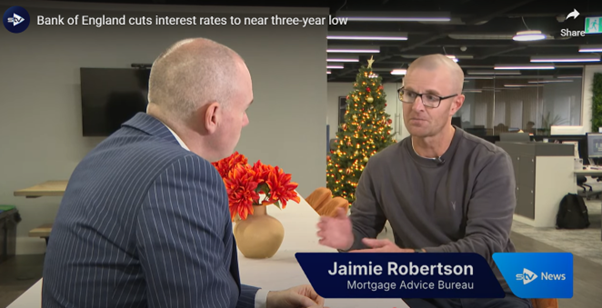
We were proud to see Jaimie Robertson, Head of Sales, featured on STV just before Christmas, offering his expert insight following the Bank of England’s recent base rate cut.
Jaimie discussed what the change means for buyers, and those looking to remortgage – highlighting how the shift could signal renewed confidence in the housing market.
His perspective reflects MAB’s continued commitment to helping customers make informed decisions in a fast-moving mortgage landscape.

Collated and developed by Maven
The information pertained in here is not intended for public consumption, it has been prepared for the partners and friends of Mortgage Advice Bureau. Please do not share with consumers or buyers. Thank you.
Your home may be repossessed if you do not keep up repayments on your mortgage.
In some instances, there may be a fee for mortgage advice. We will not charge a fee to those purchasing a new build home who contact us via the details provided. Other branches of Mortgage Advice Bureau may charge a fee. The actual amount you pay to them will depend on your circumstances. The fee is up to 1% but a typical fee is 0.3% of the amount borrowed.
Images courtesy of fxquadro